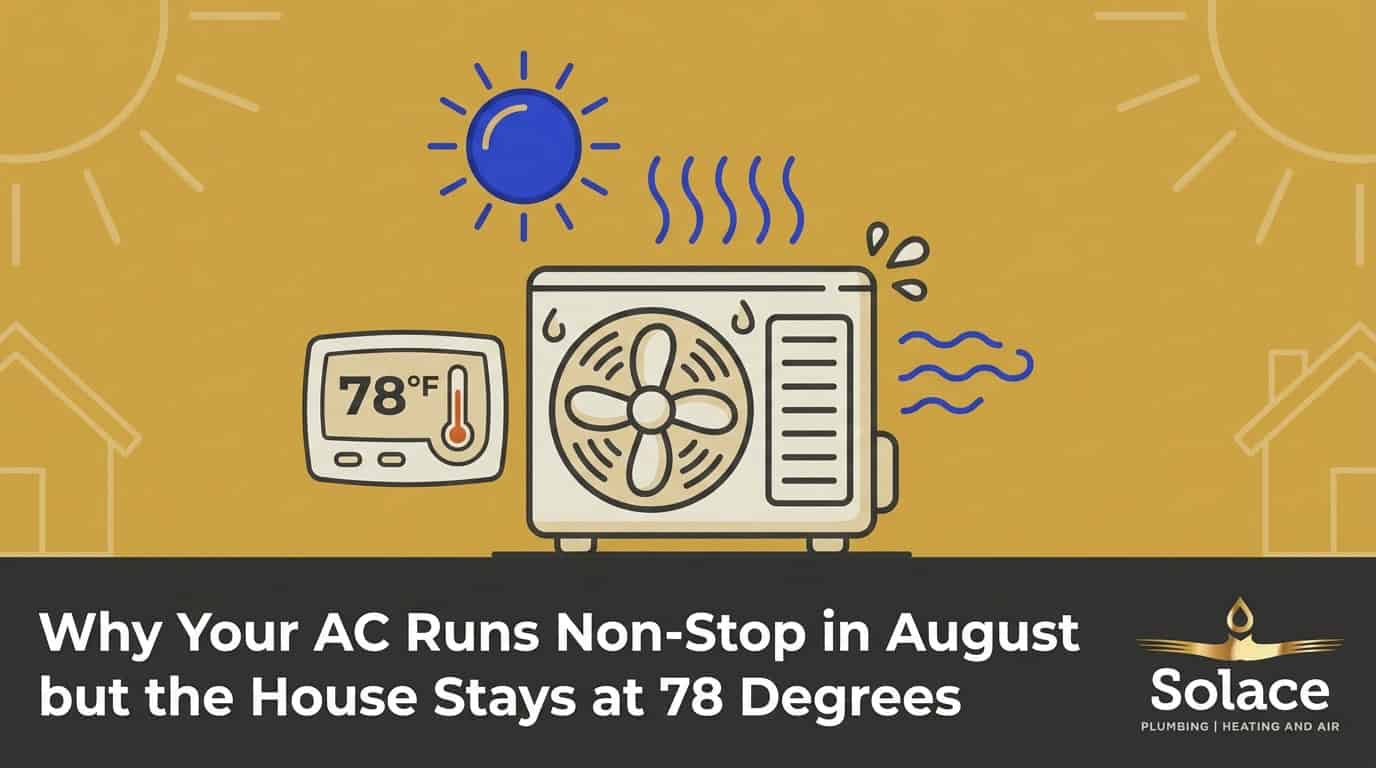
Why Your AC Is Running 24/7 This August (And Why You Shouldn’t Panic Yet)
Are you wondering exactly why your AC runs non-stop in August but the house stays at 78 degrees, even though you have the thermostat set much lower? You are definitely not alone. At Solace Plumbing Heating and Air, our dispatchers hear this exact concern daily as kids head back to school and the late-summer heat peaks. It is incredibly frustrating to hear your condenser unit humming away outside all afternoon, only to realize your indoor temperature is stuck at 78 degrees with the thermostat set to 72. Your first instinct is likely to assume the system is completely broken and requires an expensive, immediate repair.
Before you turn off the system in frustration, you need to understand the core decision point: distinguishing between an air conditioning unit that is simply operating at its maximum design capacity and a unit that has suffered an actual mechanical failure. Sometimes, your system is doing exactly what it was engineered to do, even if the result feels a little too warm for your preference. Whether you need comprehensive HVAC and plumbing services or you are ready to contact our team for an AC inspection, understanding your system’s mechanical limits is the absolute first step to restoring your home’s comfort.
Understanding the 20-Degree Temperature Differential in Extreme Heat
To understand why your system seems to be struggling during the August late-summer peak heat, you have to look at how residential cooling systems are actually designed. Air conditioners do not magically create cold air; they remove heat from inside your home and transfer it outside. The capacity to move that heat is limited by physical engineering standards.
The Department of Energy Sizing Guidelines
When our technicians explain cooling limits to homeowners, we always start with the guidelines set by the Department of Energy (DOE) and standard HVAC sizing protocols. According to these industry rules, a properly sized air conditioner is designed to maintain a 20-degree temperature differential between the outdoor air and the indoor air. This means the system can reliably cool your home to roughly 20 degrees lower than whatever the thermometer reads outside.
Rancho Cucamonga frequently experiences intense, dry late-summer temperatures exceeding 95 to 100 degrees. When the weather gets this extreme, the 20-degree rule becomes highly relevant to your daily comfort. Here is a breakdown of how the math works in real-world extreme heat:
- 90°F Outside: Your system can easily reach and maintain a comfortable 70°F indoors.
- 95°F Outside: Your system will run longer cycles to maintain an indoor temperature around 75°F.
- 100°F Outside: The lowest temperature your system can physically achieve is roughly 80°F.
- 105°F Outside: Your system will run continuously just to keep the house at a warm but safe 85°F.
Why Reaching 72 Degrees is Mathematically Impossible
If the temperature outside in the Inland Empire hits 100 degrees, an indoor reading of 78 degrees actually means your system is overperforming and successfully achieving a 22-degree differential. It is operating perfectly. Expecting your system to reach a 72-degree indoor target during extreme heatwaves is mathematically impossible for most standard residential units. The equipment simply does not have the capacity to remove that volume of heat from your home fast enough to overcome the thermal load pressing against your roof and walls.

Airflow Restrictions: The Hidden Reason Your AC Can’t Keep Up
If the outdoor temperature is only 85 degrees and your system still cannot cool the house, you are no longer dealing with a system capacity limit. You are likely dealing with an airflow restriction. In our experience, this is the most common, easily fixable cause of continuous operation that isn’t related to extreme outdoor weather.
The Impact of Clogged Air Filters
Your air conditioner relies on a steady, unobstructed flow of warm indoor air passing over the cold evaporator coil inside your home. Clogged air filters are the primary cause of airflow restrictions that force units to run continuously. In Rancho Cucamonga, where dry winds kick up significant amounts of dust and allergens, filters trap debris very quickly. When the filter becomes a solid wall of dirt, the blower motor has to work twice as hard to pull air through it.
Because less air is moving over the cold coil, the system cannot remove heat and humidity from your home at its normal pace. The thermostat registers that the room is still warm, so it commands the air conditioner to keep running. The system runs 24/7, wasting massive amounts of energy, yet the house never actually cools down.
Blocked Vents and Closed Registers
Airflow restrictions also happen at the room level. A pattern we see often on service calls is homeowners mistakenly believing that closing vents in unused guest rooms will redirect cold air to the master bedroom or living room. This is a myth. Closing registers actually increases the static pressure inside your ductwork, backing up the airflow and forcing the blower motor to strain against the pressure. Furniture placed directly over floor registers, or heavy curtains blocking wall returns, create the exact same restriction. Your system needs to breathe freely to cool your home efficiently.
Mechanical Failures: Refrigerant Leaks and Struggling Compressors
When airflow is clear but the system remains stuck at 78 degrees with the thermostat set to 72 on a mild day, you are likely facing a serious technical issue. Mechanical failures prevent the system from executing the heat transfer process, forcing the equipment to run constantly with zero cooling output.
Low Refrigerant Levels and Leaks
Refrigerant is the chemical lifeblood of your air conditioner. It travels between the indoor and outdoor units, absorbing heat from inside your house and releasing it outside. Air conditioners do not consume refrigerant like a car consumes gas; it circulates in a closed loop. If your system is low on refrigerant, it means you have a leak. Without enough refrigerant, the system cannot absorb enough heat to lower your indoor temperature. The unit will run constantly in a desperate attempt to reach the thermostat setting, but it will blow lukewarm air from the vents.
Dirty Condenser Coils
The outdoor unit, known as the condenser, has one primary job: releasing the heat gathered from your home into the outside air. The condenser is wrapped in delicate metal fins known as coils. When our team inspects outdoor units at the end of the summer season, we frequently find these coils caked in dirt, grass clippings, pet hair, and dust. This layer of grime acts as an insulating blanket. When the coils are insulated by dirt, they fail to release the absorbed heat to the outside air. The heat stays trapped in the refrigerant cycle, and the system runs continuously without making your home any cooler.
Symptoms of a Failing Compressor
The compressor is the heart of your outdoor unit, responsible for pressurizing the refrigerant and keeping it moving. Pushing a struggling compressor under the continuous late-summer workload can cause it to overheat and fail entirely. Symptoms of a failing compressor include hard starting (a loud buzzing or clicking before the fan turns on), tripping circuit breakers, and the unit running constantly while producing zero cold air. When overworked systems finally break down, Solace Plumbing Heating and Air is known for rapid response times for critical late-summer AC failures, ensuring your home isn’t left dangerously hot for days on end.
Is Your AC Unit Simply Undersized for Peak Summer Heat?
Sometimes, the issue isn’t a broken part or a dirty filter. Sometimes, the equipment itself is just too small for the physical footprint of your home. System sizing issues often remain completely hidden during mild spring weather, only becoming painfully apparent during the hottest times of the year.
What “Undersized” Actually Means
An undersized AC unit lacks the cooling capacity (measured in BTUs or tons) to overcome the thermal load of your house. During the mild days of June, an undersized unit might perform perfectly fine, easily maintaining a comfortable 72 degrees. However, when the August late-summer peak heat arrives, the thermal load on your home increases drastically. The undersized unit simply cannot remove heat as fast as the sun is baking it into your roof and walls. The result is a system that turns on at 10:00 AM and never shuts off until midnight.
Accelerated Wear and Tear
Continuous operation accelerates wear and tear on an improperly sized system. Air conditioners are designed to run in cycles—turning on, cooling the space, and turning off to rest. When a unit runs 24/7 for weeks at a time, the blower motor, capacitor, and compressor endure massive amounts of thermal stress. This constant strain drastically reduces the overall lifespan of the equipment and leads to frequent, unexpected breakdowns.
The Importance of Professional Load Calculations
You cannot guess the correct size for an air conditioner based solely on square footage. Our team performs professional Manual J load calculations to confirm if a system is genuinely undersized for a home’s layout. This calculation factors in the number of windows, the quality of your attic insulation, the direction your home faces, ceiling height, and even the heat generated by your kitchen appliances. If your system is running non-stop but the house won’t cool down, an expert evaluation is the only way to know if you need a larger unit.
Safe Troubleshooting: What to Check Before Calling a Professional
It is very important to establish clear boundaries between safe homeowner maintenance and dangerous repairs that require a licensed professional. When customers call us in a panic, these are the first safe steps we recommend checking before scheduling a service visit.
Safe DIY Troubleshooting Steps
- Check the air filter: Locate your return vent or air handler, pull out the filter, and hold it up to a light. If you cannot see light passing through the material, the filter is clogged and must be replaced immediately.
- Inspect indoor vents: Walk through every room in your Rancho Cucamonga home and ensure all supply registers and return grilles are fully open. Move any rugs, couches, or heavy curtains that might be blocking the airflow.
- Clear the outdoor unit: Go outside and inspect the condenser. Ensure there is at least two feet of clear space around the entire unit. Remove any fallen branches, overgrown bushes, or accumulated leaves that are choking the airflow.
- Check the thermostat settings: Verify that the thermostat is set to “Cool” and the fan is set to “Auto” rather than “On.” If the fan is set to “On,” it will blow air constantly, even when the compressor isn’t actively cooling.
When to Stop and Call a Pro
We strongly warn against attempting to perform deep mechanical repairs on your own. Never attempt to check refrigerant levels yourself; handling refrigerant requires strict EPA certification and specialized gauges. Do not attempt to clean internal evaporator coils, as the metal fins are razor-thin and easily crushed, which will ruin the coil entirely. Finally, never attempt to diagnose compressor electrical issues without a license. The capacitors inside your condenser hold a high-voltage electrical charge that can cause serious injury even when the power to the house is turned off.
Frequently Asked Questions: Late-Summer Cooling Struggles
What to do if AC is set to 72 but reads 78?
First, check the outdoor temperature to see if it exceeds 98°F. If it is extremely hot outside, your system is likely maxed out and operating normally under the 20-degree differential rule. Next, verify your air filter is clean and airflow is unrestricted throughout the house. If the outdoor temperature is mild (under 90°F) and the unit still struggles to reach the set temperature, you should schedule a professional inspection to check for mechanical issues.
Is it normal for AC to run constantly in 100 degree weather?
Yes, it is often normal for an AC to run continuously when temperatures reach 100°F. The system is working at its maximum design capacity to maintain a 20-degree differential between the outdoor and indoor air. As long as the indoor temperature remains around 78°F to 80°F during the hottest part of the day, the system is functioning exactly as engineered.
Why is my AC running but the temperature is going up?
This indicates a severe airflow restriction, a refrigerant leak, or a failing compressor that has stopped producing cold air entirely. When the system runs but the house gets hotter, the unit is consuming electricity without executing the heat transfer process. Turn the system off at the thermostat immediately to prevent further electrical or mechanical damage, and contact a licensed technician right away.
How many degrees below outside temp can an AC cool?
Standard residential air conditioners are designed to cool a home by a maximum of 20 degrees compared to the outdoor temperature. While an oversized unit might occasionally push past this limit, standard industry sizing dictates that a 100-degree day will yield an 80-degree indoor environment when the system is running at peak efficiency.
Will running my AC 24/7 damage the compressor?
While systems are designed to handle heavy loads, continuous operation over multiple days increases wear and tear on the internal components. The compressor generates a massive amount of heat while running, and running non-stop prevents it from cooling down between cycles. Regular maintenance is essential to ensure the compressor can handle this sustained strain without failing prematurely.
How often should I change my filter during peak summer heat?
During continuous operation in late summer, filters should be checked every 30 days. Because the blower motor is running constantly, it is pulling dust and debris out of the air at a much faster rate than it does in the spring. Homes with pets, older ductwork, or high indoor dust levels may need replacements even more frequently to prevent severe airflow restrictions.
Restore Your Home’s Comfort Before the Heatwave Ends
Understanding your system’s limits is the first step to staying comfortable during the August late-summer peak heat. When the temperatures outside soar past 100 degrees, a house sitting at 78 degrees means your equipment is working hard and doing its job. However, if the weather is mild and your unit is still running constantly without lowering the temperature, you likely have a hidden airflow restriction or a looming mechanical failure.
If basic troubleshooting like changing the air filter and clearing the outdoor condenser doesn’t work, our local experts at Solace Plumbing Heating and Air can diagnose the true issue. Don’t let a struggling compressor turn into a complete system breakdown. Reach out to our licensed professionals to evaluate your equipment, check your refrigerant levels, and ensure your home stays cool and safe for the rest of the season. If a system upgrade is ultimately necessary, we can also help you explore qualifying high-efficiency installations that may be eligible for generic utility incentive programs or federal tax credits (always check with your tax professional for current availability).