
The Hidden Threat Inside Your Tank: The Myth of the Maintenance-Free Water Heater
Your hot water is running out faster than it used to, and that strange rumbling noise from the garage isn’t going away on its own. If you want to know exactly why skipping your annual water heater flush accelerates hard water damage, the answer begins with a very common misconception: the myth of the maintenance-free plumbing appliance. At Solace Plumbing Heating and Air, our technicians see this firsthand every week. Many homeowners operate under the assumption that a newer water heater can simply be installed and left completely alone until the day it eventually breaks down. Unfortunately, plumbing systems do not work that way, especially when dealing with local water conditions.
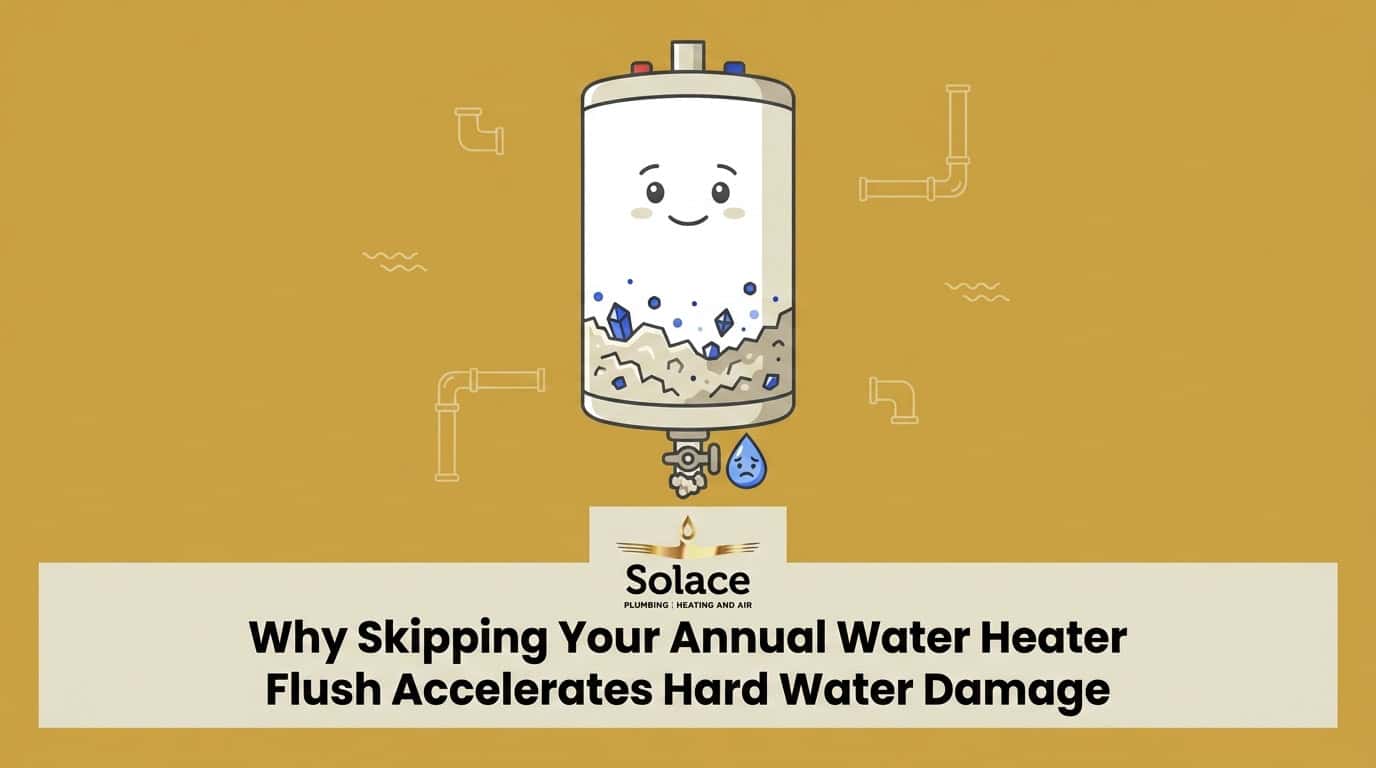
The reality is that a hidden threat is actively compromising your system every single day. While your water heater silently does its job, hard water mineral buildup is constantly calcifying inside your tank. This hardened scale coats the internal components, slowly but surely destroying your heating elements and reducing the overall volume of your tank. Out of sight often means out of mind, but the damage accumulating inside the steel cylinder is very real.
When you live in an area like Rancho Cucamonga, ignoring this silent deterioration forces a critical decision point. You can either continue running a severely strained system under the false assumption that it doesn’t need care—risking a total breakdown when you need hot water the most—or you can proactively schedule a professional flush before the colder winter months demand peak performance from your plumbing. Understanding exactly what is happening inside that tank is the first step toward protecting your investment.
How High Temperatures Transform Dissolved Minerals into Solid Rock
To understand why your water heater is under attack, you have to look at the water itself. In our experience working across the Inland Empire, we know the region relies heavily on groundwater sources that frequently exhibit hard to very hard water mineral concentrations. As groundwater travels through the earth, it acts as a natural solvent, picking up microscopic traces of rock, chalk, and soil. By the time this water reaches your home’s main supply line, it is heavily saturated with invisible, dissolved minerals.
The problem: Cold hard water flows through your pipes relatively harmlessly. However, the moment that mineral-heavy water enters your water heater and encounters intense heat, a drastic chemical reaction occurs. Heat acts as a catalyst that fundamentally changes the solubility of the water.
The cause: When the water temperature rises, the liquid can no longer hold the same volume of dissolved minerals. As a result, these minerals precipitate out of the water. They transition from an invisible dissolved state into solid microscopic particles. Over months of constant heating and cooling cycles, these particles settle to the bottom of the tank and bake onto the interior surfaces, forming a rock-hard layer of calcium carbonate scale.
The solution: Recognizing this inevitable chemical reaction highlights why regular intervention is non-negotiable. You cannot stop the precipitation process, but you can remove the resulting calcium and magnesium sediment buildup before it hardens into an impenetrable shell.
The Role of Calcium and Magnesium
The two primary culprits behind hard water scale are calcium and magnesium. These naturally occurring alkaline earth metals are completely safe for human consumption, but they are incredibly destructive to plumbing appliances. According to U.S. Geological Survey (USGS) classifications, water hardness is measured by the concentration of these specific minerals.
| USGS Water Hardness Classification | Mineral Concentration (mg/L) | Impact on Water Heaters |
|---|---|---|
| Soft Water | 0 – 60 | Minimal scale formation; standard lifespan expected. |
| Moderately Hard | 61 – 120 | Moderate scale; annual flushing is highly recommended. |
| Hard Water | 121 – 180 | Rapid scale formation; annual flushing is absolutely critical. |
| Very Hard Water | Over 180 | Severe calcification; extreme risk of premature element burnout. |
Because our local groundwater sources in Rancho Cucamonga frequently fall into the “Hard” or “Very Hard” categories—something our plumbing team tests and confirms regularly—the precipitation of calcium and magnesium inside your tank happens at a highly accelerated rate compared to the national average. This localized geographical challenge requires a proactive approach to maintenance.
The Insulator Effect: Why Heating Elements Burn Out Prematurely
The most immediate and costly consequence of calcium and magnesium sediment buildup is what we in the industry call the “insulator effect.” When our team pulls a failed heating element from a neglected tank, it is almost always buried under a thick crust of scale. To understand why this happens, you must picture the internal mechanics of your water heater. In an electric unit, thick metal heating elements protrude directly into the water. In a gas unit, a burner assembly heats the bottom plate of the tank to transfer warmth upward. In both designs, the heat source must maintain direct thermal contact with the water to operate efficiently.
As dissolved minerals precipitate out of the hot water, they don’t just settle harmlessly on the floor of the tank. They cling to the hottest surfaces available. Over time, this solid scale wraps around the electric heating elements or heavily coats the bottom of the gas tank. Calcium carbonate is an exceptionally effective thermal insulator—meaning it actively blocks heat from escaping.
The devastating cycle of overheating:
- Blocked heat transfer: The heating element turns on, but the thick layer of scale prevents that heat from reaching the water.
- Continuous operation: Because the water isn’t reaching the target temperature set by the thermostat, the system is forced to run continuously.
- Internal component stress: The heating elements become trapped in their own heat, causing the internal metal to reach dangerously high temperatures.
- Premature burnout: Forced to work longer, harder, and much hotter than designed, the components eventually warp, short out, or fail completely.
This insulator effect doesn’t just destroy your equipment; it silently drives up your daily energy consumption. Your system is burning more gas or drawing more electricity simply to push heat through a thick wall of solid rock. By the time the water finally gets hot, you have already paid a premium in wasted energy.

Popping, Rumbling, and Reduced Capacity: Recognizing the Warning Signs
Because the damage is happening behind a steel wall, homeowners often miss the early stages of calcification. However, as the scale thickens, the system will begin to show physical and audible symptoms. Recognizing these early indicators is crucial for preventing a complete system failure. If you live in Rancho Cucamonga and notice any of the following behaviors, your water heater is already under severe strain—and it’s usually the point where our dispatch center starts getting emergency calls.
- Loud popping or rumbling noises: This is the most common and alarming symptom of severe sediment buildup. The sound is often described as popcorn popping or rocks tumbling in a dryer. What you are actually hearing is water boiling underneath the layer of sediment. As the heat source warms the bottom of the tank, water trapped under the mineral crust turns to steam, expands, and violently bursts through the sediment layer. This micro-boiling places immense stress on the tank’s inner glass lining.
- A sudden drop in hot water capacity: If your family used to take three consecutive showers without an issue, but now the water runs cold halfway through the second, sediment is likely to blame. Solid scale takes up physical space inside the tank. If you have a 50-gallon water heater with 10 gallons of solid sediment displaced at the bottom, you now only have a 40-gallon water heater.
- Fluctuating water temperatures: When scale coats the internal temperature sensors and heating elements, the thermostat struggles to accurately read the water temperature. This leads to lukewarm water one day and scalding hot water the next, as the system erratically cycles on and off.
- Cloudy or discolored hot water: If the hot water coming from your faucets looks milky or has a rusty tint (while the cold water remains clear), it is a strong indicator that sediment is being agitated inside the tank and pushed out through your plumbing lines.
Ignoring these symptoms will inevitably lead to emergency breakdowns. Learning to identify the signs that you need a water heater repair ensures you can address the root cause of the strain before the internal components are damaged beyond recovery.
Why Timing Matters for Winter Plumbing Protection
While water heater maintenance is important year-round, we always advise our customers that the timing of your annual flush plays a massive role in system longevity. The September pre-fall transition is widely considered the ideal window for proactive plumbing protection. The reason comes down to the temperature of the incoming groundwater and the concept of thermal strain.
During the peak of summer, the groundwater flowing into your home is relatively warm. Your water heater doesn’t have to work exceptionally hard to raise that water to the standard 120 degrees Fahrenheit. However, as winter approaches, the temperature of the incoming groundwater drops significantly. This creates a much larger “delta-T” (temperature difference) that the system must overcome.
If your water heater enters the winter season already handicapped by a thick layer of summer sediment buildup, the sudden demand for more intense, prolonged heating cycles can be the final straw for older heating elements. The system is forced to work harder to heat colder water, all while fighting through a thick layer of insulating scale. By scheduling a professional flush during the early fall, you clear out the accumulated debris, restore optimal heat transfer, and ensure the system is operating at peak efficiency right before the coldest weather arrives. This proactive step is the difference between a comfortable winter and a freezing cold morning shower.
The Risks of Ignoring Scale and the Danger of DIY Flushing
The consequences of leaving a water heater to fend for itself are severe. Beyond the immediate frustration of high energy bills and lukewarm showers, ignoring calcium and magnesium sediment buildup drastically shortens the lifespan of the entire unit. When popping and rumbling noises occur, the expanding steam bubbles can slowly crack the protective glass lining inside the steel tank. Once water reaches the raw steel, irreversible rust and corrosion begin, inevitably leading to a catastrophic tank leak that can flood your garage or home.
The problem with DIY maintenance: With thousands of generic tutorials online, many homeowners are tempted to attach a garden hose and attempt to flush the tank themselves. Our team has had to rescue countless DIY projects gone wrong, and we highly discourage this approach as it is often dangerous. Attempting a DIY flush on a system that has been neglected for years frequently creates more problems than it solves.
The cause of DIY failures: The drain valves on most residential water heaters are made of standard plastic. Over years of exposure to extreme heat and hard water, this plastic becomes incredibly brittle. When a homeowner attempts to force a stuck valve open, it can easily snap off, resulting in scalding hot water uncontrollably flooding the area. Furthermore, large chunks of hardened scale can quickly clog the narrow valve opening, preventing the tank from draining and leaving the homeowner with a half-empty, inoperable system. There is also the severe risk of scalding injuries if the pressure relief valve is mishandled.
The professional solution: Protecting your home requires specialized knowledge. Our team at Solace Plumbing Heating and Air brings deep local expertise regarding Inland Empire water quality and a commitment to extending the lifespan of residential plumbing systems. A professional flush involves much more than just draining water. A licensed technician will safely manage the thermal pressure, use specialized equipment to clear stubborn scale blockages, inspect the critical temperature and pressure (T&P) relief valve for safety, and evaluate the condition of the sacrificial anode rod—a vital component that prevents the tank itself from rusting. This comprehensive approach guarantees the system is not only clean but structurally safe.
Frequently Asked Questions About Hard Water and Water Heaters
What happens if I don’t flush my water heater with hard water?
If you skip maintenance in a hard water area, sediment rapidly accumulates at the bottom of the tank. This buildup forces the system to run longer to heat the water, leading to a massive drop in energy efficiency. Over time, the trapped heat causes premature element failure, and the constant stress can crack the tank’s glass lining, eventually leading to irreversible rust and catastrophic leaks.
Why is my water heater making a popping noise?
That alarming popping or rumbling noise is caused by water trapped underneath a thick layer of solid sediment. As the heating element warms the bottom of the tank, the trapped water reaches a boiling point and turns into steam. The steam bubbles violently burst through the mineral crust, creating the popping sound and placing structural stress on the tank.
Can a water heater explode from sediment?
While an actual explosion is rare due to built-in safety mechanisms like the Temperature and Pressure (T&P) relief valve, severe neglect is still dangerous. If heavy scale buildup compromises or clogs the T&P valve, the tank loses its ability to vent excess pressure safely. This can lead to dangerous pressure spikes, severe leaks, or ruptured fittings.
Does flushing a water heater actually help?
Yes, flushing is the single most effective way to protect your unit. Removing the loose sediment and scale restores the system’s energy efficiency and stops the destructive insulating effect on the heating elements. Regular flushing directly extends the lifespan of the tank and ensures you have a consistent supply of hot water.
How quickly does hard water scale form?
In areas with “Hard” or “Very Hard” mineral content, such as Rancho Cucamonga, significant scale can form in less than a single year. The higher the mineral concentration and the hotter the water is kept, the faster the calcium and magnesium precipitate out, making annual professional maintenance absolutely critical for local homes.
Protect Your Hot Water Supply Before the Cold Weather Arrives
The myth of the maintenance-free water heater costs homeowners heavily every single year. The relationship between hard water, rapid calcification, and premature system failure is a simple matter of chemistry and physics. When dissolved minerals are heated, they turn into solid rock, insulating your heating elements and forcing your system to work itself to death.
You don’t have to wait for a sudden breakdown to take action. By utilizing the September pre-fall transition to schedule a professional flush, you clear out the summer’s sediment accumulation just in time for the colder months. This proactive approach ensures your equipment operates efficiently, safely, and reliably when you need it most. Protect your daily comfort and your plumbing investment by having our Rancho Cucamonga experts evaluate, clean, and optimize your water heater today.