
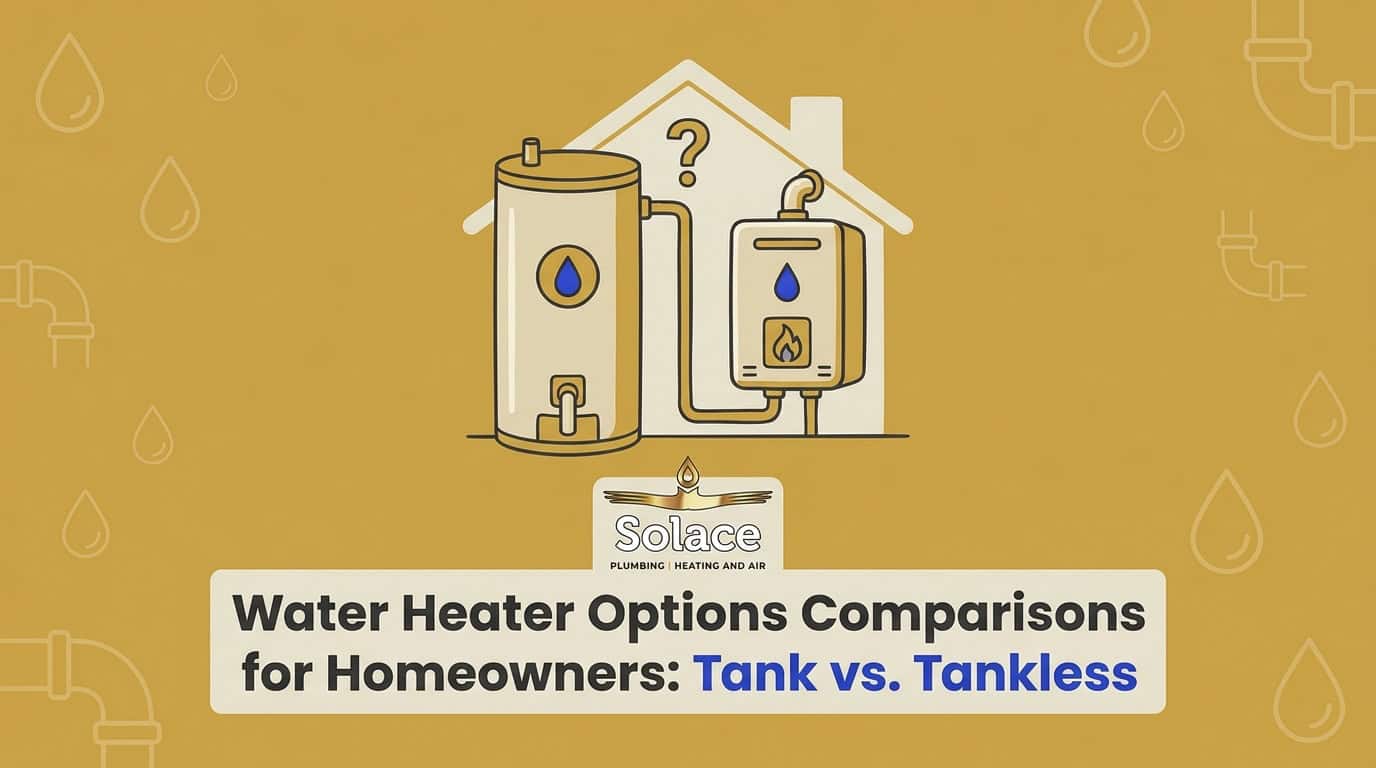
Facing Cooler Months: Why Now is the Time to Assess Your Hot Water Needs
Waiting for the shower to warm up only to be met with lukewarm water is a frustrating problem, making water heater options comparisons for homeowners a top priority before the seasons fully change. At Solace Plumbing Heating and Air, we constantly remind our customers that while your current water heater might be keeping up right now, as we move into pre-winter October, aging systems often begin to show their hidden weaknesses. The sudden chill of a morning shower or a tank that runs out halfway through washing dishes are clear indicators that your household’s hot water demand is outpacing your equipment’s capabilities.
Evaluating your replacement options early is crucial, especially before the cold sets in and holiday hosting demands peak. A failing water heater doesn’t just disrupt your morning routine; it can lead to sudden leaks or total system breakdowns right when you need reliability the most. Addressing this proactively allows you to weigh the benefits of different technologies without the pressure of an emergency replacement.
Furthermore, evaluating your water heater is an excellent opportunity to assess the broader health of your home’s infrastructure. Maintaining overall system health with professional plumbing services is just as crucial as the heater itself. Upgrading an old, deteriorating tank before it ruptures prevents emergency failures and the sudden need for extensive drain cleaning or water damage mitigation. By taking action now, you secure a steady, efficient supply of hot water for the colder months ahead.
Understanding the Core Differences: Tank vs. Tankless Systems
When replacing a water heater in Rancho Cucamonga, our technicians generally help homeowners choose between two primary technologies: traditional storage tanks and on-demand tankless systems. Understanding the fundamental mechanics of each is the first step in determining which system aligns with your household’s daily routines and physical space constraints.
Traditional tank water heaters operate by continuously heating and storing a large volume of water—typically between 40 and 50 gallons for an average home. Because the water is kept hot around the clock, it is immediately available when you turn on a faucet. However, once that stored supply is depleted, you must wait for the tank to refill and reheat. On the other hand, tankless water heaters do not store water. Instead, they use powerful gas burners or electric elements to flash-heat water on demand as it flows through the unit’s heat exchanger. This provides a virtually endless supply of hot water, provided the demand does not exceed the unit’s flow rate capacity.
Physical Footprint and Lifespan
Space and longevity are major factors in this decision. Traditional tanks require a significant physical footprint, often occupying a large closet or a dedicated corner of the garage. Tankless units are compact and wall-mounted, freeing up valuable square footage. Regarding lifespan, standard tanks typically last 8 to 12 years before internal corrosion compromises the steel. Tankless models, when given proper routine care, can last up to 20 years because they do not constantly hold corrosive water.
| Feature | Traditional Tank Water Heater | Tankless Water Heater |
|---|---|---|
| Heating Method | Continuously heats and stores a set volume of water | Heats water on-demand as it flows through the unit |
| Hot Water Supply | Limited to tank capacity; requires recovery time | Continuous and virtually endless |
| Space Required | Large footprint; floor installation | Compact; wall-mounted |
| Expected Lifespan | 8 to 12 years | Up to 20 years (with proper maintenance) |
Ultimately, the right choice depends heavily on local conditions, household routines, and peak usage times. What works perfectly for a two-person household may struggle to keep up with a large family.

Evaluating Hot Water Demands for Late-Year Holiday Hosting
The transition into pre-winter October brings a significant shift in how households use hot water. The most critical factor in choosing a new water heater is understanding your home’s peak demand, particularly during late-year holiday hosting. Having guests over means more consecutive showers, extra loads of laundry, and the dishwasher running constantly—often all at the same time.
The problem: A pattern we see often is homeowners upgrading to a tankless system expecting endless hot water, only to find the water turning lukewarm when two showers and the washing machine are running simultaneously. Alternatively, homes with traditional tanks often run out of hot water entirely after the third consecutive morning shower, forcing the fourth person to wait for the tank to recover.
The cause: A traditional tank provides a large initial volume of hot water, but once that 50-gallon reserve is gone, the burner takes time to heat the incoming cold water. A tankless system never runs out of hot water, but it is limited by its Gallons Per Minute (GPM) flow rate. If the simultaneous demand from multiple fixtures exceeds the tankless unit’s maximum GPM, the system simply cannot heat the water fast enough, resulting in a temperature drop across all active fixtures.
Calculating Your Peak GPM
The solution: Properly sizing the unit based on peak demand. To determine if a tankless system will support your holiday hosting needs, you must calculate your peak GPM. Consider the flow rates of common household fixtures:
- Standard showerhead: 2.5 GPM
- Bathroom sink faucet: 1.5 GPM
- Kitchen sink faucet: 2.0 GPM
- Dishwasher: 1.5 GPM
If you expect two showers and the dishwasher to run at the same time during Thanksgiving morning, your tankless water heater must be able to handle a demand of at least 6.5 GPM. If your calculated peak demand is exceptionally high, a high-capacity tankless unit, multiple tankless units, or a large traditional tank might be required to maintain comfort.
How Cooler Fall and Winter Groundwater Temperatures Affect Performance
A frequently overlooked factor in water heater performance is the temperature of the incoming municipal water supply. While it is easy to assume the water entering your home is a constant temperature year-round, incoming groundwater temperatures drop significantly in late fall and winter. Even in Southern California, winter groundwater temperature drops are significant enough to impact undersized tankless units.
Understanding Temperature Rise
To understand why this matters, you must understand “temperature rise.” This term refers to the amount of work the water heater must do to bring the cold incoming water up to your desired set temperature (usually around 120 degrees Fahrenheit).
In the middle of summer, the incoming water might be 70 degrees. To reach 120 degrees, the water heater only needs to achieve a temperature rise of 50 degrees. However, by pre-winter October and into December, that incoming water might drop to 55 degrees or lower. Now, the system must achieve a temperature rise of 65 degrees.
For a traditional tank, this simply means the burner runs a little longer to heat the stored water. For a tankless system, the impact is immediate. Because a tankless unit heats water instantly as it flows, a higher required temperature rise means the unit must slow down the flow of water to ensure it reaches 120 degrees before exiting the heat exchanger. This means a tankless unit rated for 8 GPM in the summer might only deliver 5 GPM in the winter.
This is where local Inland Empire expertise is crucial. Unlike big national chains that use generic, nationwide sizing charts, our team at Solace Plumbing Heating and Air understands exactly how cold the groundwater gets in our specific area. We size systems to ensure you never experience lukewarm water during the coldest months of the year.
The Impact of Hard Water on Water Heater Longevity and Efficiency
Beyond temperature, the chemical makeup of your local water supply plays a massive role in the health and efficiency of your plumbing appliances. Rancho Cucamonga and the broader Inland Empire are known for having notably hard water—a challenge our plumbers mitigate every single day. Hard water contains high levels of dissolved minerals, primarily calcium and magnesium.
When hard water is heated, these minerals precipitate out of the water and form scale—a hard, chalky deposit that clings to the inside of pipes, tank walls, and heat exchangers. This scale buildup accelerates wear inside both tank and tankless systems, but it affects them differently.
How Scale Reduces Efficiency
In a traditional tank water heater, scale settles at the bottom of the tank, right above the gas burner. This thick layer of sediment acts as an insulator. The burner must first heat the layer of rock-hard scale before it can heat the water, forcing the unit to burn significantly more energy to achieve the same results. This not only drives up utility costs but also causes the bottom of the tank to overheat, leading to premature failure and leaks.
Tankless systems are particularly sensitive to hard water. Because their internal heat exchangers use narrow, winding pathways to flash-heat the water, even a small amount of scale can restrict water flow and block heat transfer. If scale is left unchecked, the system will overwork itself, display error codes, and eventually fail. Routine professional descaling is absolutely mandatory to maintain a tankless system’s efficiency and keep its warranty valid.
Heavy mineral buildup doesn’t stop at the water heater. It affects your entire plumbing system. The same scale that coats your heat exchanger is also narrowing the interior diameter of your home’s pipes. Over time, this buildup creates rough surfaces that catch debris, leading to slow drains and blockages that often require specialized hydro jetting services to thoroughly scour the pipe walls clean.
Routine Maintenance Requirements for Optimal Winter Readiness
Whether you choose a traditional tank or a tankless system, professional maintenance is the key to longevity and winter reliability. As we approach pre-winter October, our team highly recommends scheduling a comprehensive tune-up to ensure your equipment is prepared for the heavy usage of the holiday season.
It is critical to note that water heater maintenance involves direct interaction with gas lines, high-voltage electrical components, and venting systems. This work carries significant safety risks and must always be handled by a licensed professional.
Professional Maintenance for Traditional Tanks
- Anode Rod Inspection: The technician will check the sacrificial anode rod, a vital component that attracts corrosive elements in the water to protect the steel tank. If the rod is fully depleted, it must be replaced to prevent the tank from rusting out.
- Sediment Flushing: The tank must be fully drained and flushed under pressure to remove the accumulated hard water sediment from the bottom, restoring heating efficiency and preventing overheating.
- Safety Valve Testing: The Temperature and Pressure Relief (T&P) valve is tested to ensure it will properly release pressure if the tank overheats, preventing a dangerous rupture.
Professional Maintenance for Tankless Systems
- Heat Exchanger Descaling: The technician isolates the unit from the home’s water supply and uses a specialized pump to circulate a professional-grade descaling solution through the heat exchanger for 45 to 60 minutes, dissolving hard water scale.
- Filter Cleaning: The inline water filter and air intake screens are removed, cleaned, and reinstalled to ensure proper water and airflow.
- Burner and Ignition Inspection: The gas pressure is verified, and the burner assembly is inspected to ensure clean, efficient combustion.
Protecting Your Entire Plumbing System During a Water Heater Upgrade
In our years of servicing local homes, we’ve found that upgrading a water heater is a major investment, and it serves as a great time to evaluate the overall health of the home’s plumbing infrastructure. Your water heater does not operate in a vacuum; it is the heart of a larger, interconnected system. Ensuring that the rest of your plumbing is in good condition protects your new investment and guarantees optimal performance.
Increased holiday usage stresses not just the water heater, but the entire drainage system. More guests mean more showers, more toilet flushes, and heavy use of the kitchen sink and garbage disposal. This sudden spike in volume can easily overwhelm an aging sewer line that is already partially restricted by scale, grease, or tree roots. What starts as a slow drain can quickly escalate into a messy backup, sometimes revealing the need for professional sewer repair right in the middle of a family gathering.
To prevent this, many Rancho Cucamonga homeowners pair their water heater upgrade with a comprehensive drain inspection and clearing. Exploring the benefits of high pressure drain cleaning is highly recommended. This process uses highly pressurized water to blast away years of accumulated sludge, hard water scale, and blockages, ensuring the entire system is flowing freely and ready for peak capacity. A holistic approach to plumbing maintenance prevents compounding emergencies and ensures your home operates smoothly throughout the busy season.
Make an Informed Decision for Your Home’s Comfort
The choice between a traditional tank and a tankless water heater ultimately comes down to your specific household demand, available physical space, and local water conditions. While a tank offers a large reserve of hot water at a lower initial installation point, a tankless system provides endless hot water and a longer lifespan, provided it is properly sized for winter groundwater temperatures and maintained against hard water scale. Depending on the system you choose, federal tax credits or local utility incentive programs may apply to qualifying energy-efficient installations, so be sure to verify current programs with your utility provider or a tax professional.
A clear, unbiased comparison helps frame the decision for long-term comfort and efficiency. At Solace Plumbing Heating and Air, we believe that conducting thorough water heater options comparisons for homeowners ensures that you aren’t just buying a piece of equipment, but investing in a reliable daily routine for years to come. Before making a final decision, we encourage Rancho Cucamonga homeowners to consult with our local plumbing experts to evaluate their specific peak demand and infrastructure. Reach out today to explore your options and learn more about tailored plumbing solutions designed for your home.
Frequently Asked Questions
Is it worth upgrading to a tankless water heater?
Upgrading to a tankless water heater is often worth it for homeowners who plan to stay in their home long-term and want an endless supply of hot water. Because they only heat water on demand, they eliminate the standby energy losses associated with traditional tanks. Additionally, their compact size frees up valuable storage space, and with proper professional maintenance, they can outlast standard tanks by several years.
What are the disadvantages of a tankless water heater?
The primary disadvantage of a tankless water heater is the higher initial installation requirement, as they often require upgrades to gas lines and venting systems. They are also limited by their flow rate; if too many fixtures are used simultaneously, the water temperature can drop. Finally, tankless units are highly sensitive to hard water and require strict annual descaling to prevent heat exchanger failure.
How long do tank water heaters last compared to tankless?
Traditional tank water heaters typically last between 8 and 12 years before internal corrosion compromises the steel tank and causes leaks. In contrast, tankless water heaters can last up to 20 years. The longer lifespan of tankless units is primarily because they do not constantly store corrosive water, though achieving this longevity requires consistent, professional descaling.
Which water heater is best for a large family?
For a large family with high simultaneous hot water demand, a high-capacity traditional tank or a multi-unit tankless system is usually best. If four people need to shower at the same time while the dishwasher runs, a single standard tankless unit may struggle to provide the necessary flow rate. A professional plumber can calculate your exact peak Gallons Per Minute (GPM) to recommend the right configuration.
Which water heater is best for holiday hosting?
Holiday hosting creates sudden spikes in hot water demand, making sizing more important than the specific technology. A properly sized tankless water heater is excellent for consecutive showers because it never runs out of hot water. However, if guests will be using multiple bathrooms at the exact same time, a large-capacity traditional tank provides a strong initial volume to handle the simultaneous draw.
Does hard water affect tankless water heaters?
Yes, hard water heavily impacts tankless water heaters by causing mineral scale to build up rapidly inside the narrow pathways of the heat exchanger. This scale acts as an insulator, forcing the unit to burn more energy and restricting water flow. If the unit is not professionally descaled annually, hard water will cause the system to overheat, display error codes, and eventually fail prematurely.
Is a tankless water heater better for winter?
A tankless water heater performs exceptionally well in winter, provided it was correctly sized by a local professional who accounted for seasonal groundwater temperature drops. Because incoming water is much colder in the winter, the unit must work harder to achieve the desired temperature rise, which can slightly reduce its maximum flow rate. As long as this winter flow rate meets your household’s peak demand, a tankless unit will provide continuous comfort through the colder months.