
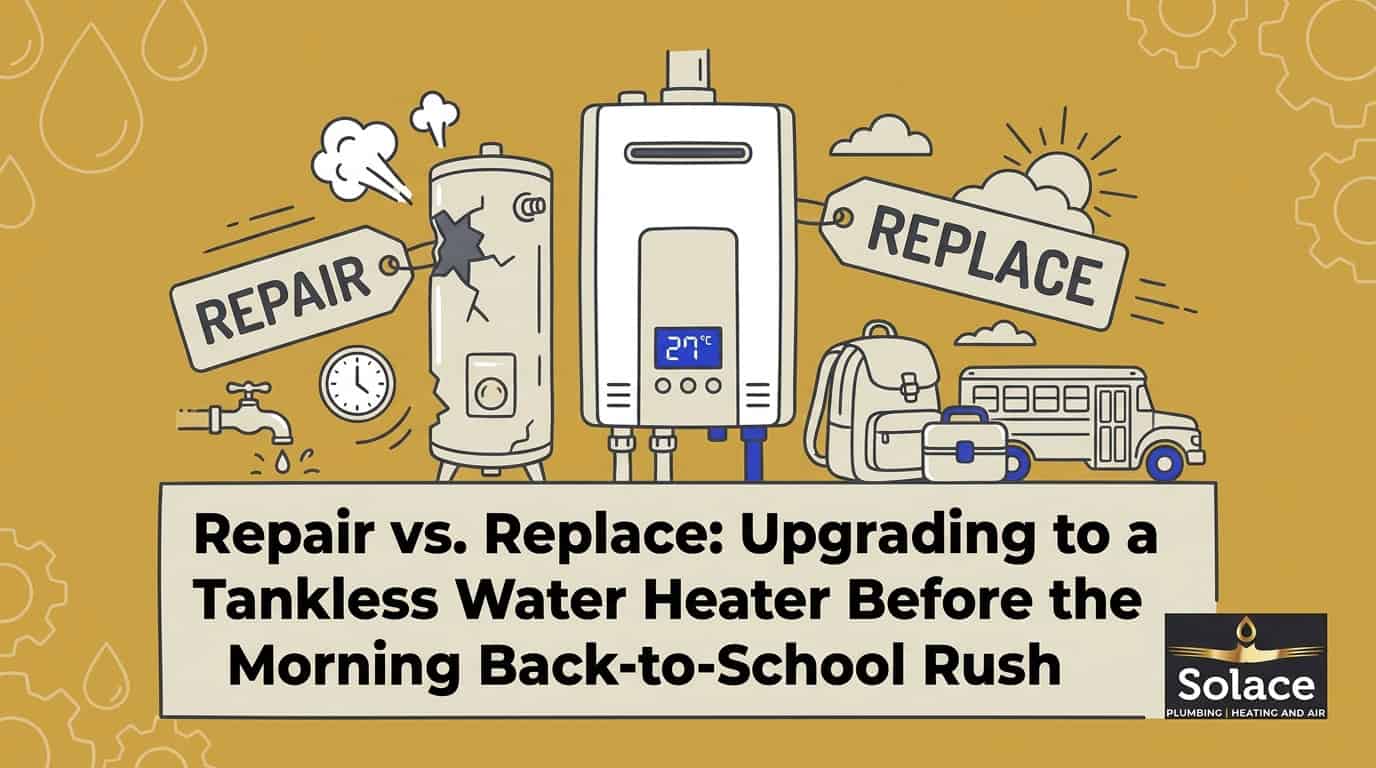
The 6:30 AM Reality Check: When Staggered Showers Are No Longer an Option
Late summer brings a sudden, jarring shift to household routines, making upgrading to a tankless water heater before the morning back-to-school rush a top priority for families. Over the summer, your schedule is flexible. Showers happen at various times throughout the day, and the demand on your plumbing system remains relatively low and spread out. But once the calendar flips to mid-August, that flexibility disappears. Suddenly, multiple family members need to shower, brush their teeth, and run the dishwasher at exactly the same time. If you are relying on a 10-year-old traditional tank, this abrupt shift in daily habits becomes the ultimate stress test for your plumbing.
Your aging system might have survived the lighter demands of July, but the August back-to-school morning rush exposes every weakness in a failing unit. The second person into the bathroom is often greeted with lukewarm water, and by the time the third person steps in, the shower is entirely cold. This creates daily frustration right when your family needs a smooth, predictable start to the day. The decision you face is clear: do you try to patch and repair a struggling, decade-old tank, or do you upgrade to a modern tankless system before the school year fully ramps up?
Need immediate help evaluating your system? Explore our residential plumbing services or learn more about gas line upgrades for tankless water heaters to get your home ready for the season.
Why Late Summer Exposes Failing Water Heaters
The problem: At Solace Plumbing Heating and Air, our team routinely fields a spike in emergency calls during this late-summer transition. Many homeowners are caught off guard when their water heater suddenly seems to fail in late August. The unit appeared to be working perfectly fine just a few weeks prior, leading to confusion about why it cannot keep up with current demands.
The cause: The hot late-summer weather in Rancho Cucamonga actually masks a failing water heater’s decline. When outside temperatures are soaring, the incoming municipal water supply is naturally warmer, meaning your water heater doesn’t have to work as hard to reach the target temperature. Furthermore, residents naturally take shorter, cooler showers during heatwaves. A compromised 10-year-old traditional tank can easily coast through these low-demand months without showing obvious symptoms of failure. However, once the August back-to-school morning rush begins, the abrupt, concentrated spike in hot water usage tests the system’s absolute limits. Rapid reheating cycles put immense mechanical stress on the aging burner and weakened tank walls.
The solution: Recognizing that the sudden failure is actually the culmination of long-term wear allows you to take proactive steps. Addressing the decline now prevents a complete, catastrophic breakdown during the busiest mornings of the year.
The Hidden Impact of Hard Water on Aging Tanks
One of the primary reasons a decade-old tank fails to meet morning demands is the invisible accumulation of mineral scale. In our years of servicing plumbing systems across Rancho Cucamonga, we see this pattern constantly due to the area’s notably hard water, which contains high levels of calcium and magnesium. Over a decade of use, these minerals precipitate out of the heated water and settle at the bottom of the tank.
- Reduced actual capacity: A thick layer of sediment physically displaces water inside the tank. A unit rated for 50 gallons might only hold 30 gallons of actual water by its tenth year.
- Insulated burners: In gas models, the burner sits at the bottom of the tank. A layer of hardened scale acts as insulation, forcing the burner to run longer and hotter just to heat the water above the sediment.
- Rapid depletion: Because the tank holds less water and takes longer to heat it, you run out of hot water halfway through a morning shower.
The Risks and Realities of Patching an Aging Tank
When faced with a sudden lack of hot water, the immediate instinct is often to call for a quick repair. While replacing a specific component might temporarily restore functionality, objectively analyzing the downsides of patching a 10-year-old traditional tank reveals significant long-term risks.
- The natural lifespan barrier: Traditional tank water heaters generally have a functional lifespan of 8 to 12 years. Once a unit crosses the decade mark, the structural integrity of the steel tank itself is usually compromised by corrosion.
- The band-aid effect: Swapping out a faulty thermocouple or replacing a burned-out heating element will get the unit firing again, but it does absolutely nothing to address the heavy sediment buildup that is actively reducing your hot water capacity.
- The risk of catastrophic leaks: As the internal glass lining of an aging tank cracks and the steel rusts, the bottom of the tank becomes paper-thin. A sudden rupture will dump dozens of gallons of rusty water into your garage or utility closet, causing extensive water damage.
If you are constantly dealing with hard water scale, you might also want to explore water filtration systems to protect your entire plumbing infrastructure. However, for a tank that is already a decade old, the damage is already done.
Diminishing Returns on Repair Investments
Evaluating the practical timeline of repeated service calls is crucial. Piecemeal repairs on an aging system often lead to a full replacement shortly after. You might spend a portion of a replacement budget on a temporary fix, only to face another component failure two months later. Investing repair funds into a system that has already reached the end of its engineered lifespan is rarely a sound financial decision, especially when it leaves your household vulnerable to ongoing morning disruptions.
Meeting Simultaneous Morning Demands with a Tankless Upgrade
If your primary goal is surviving the August back-to-school morning rush without arguments over who gets the warm water, upgrading to a tankless system offers a definitive solution. Instead of holding a stagnant reserve of heated water, these systems utilize advanced on-demand heating mechanisms.
Continuous flow technology: When you open a hot water tap, a flow sensor detects the movement and ignites the high-powered burner. The water flashes hot as it passes through a highly efficient heat exchanger, delivering a continuous flow of 2 to 5+ gallons of hot water per minute. Because there is no tank to empty, you literally cannot run out of hot water.
Handling overlapping routines: This technology easily supports back-to-back or simultaneous showers without a drop in temperature. One child can be showering upstairs while another is showering downstairs, and the dishwasher can be running in the kitchen—all at the same time. The system simply modulates its burner output to match the precise demand.
Eliminating recovery periods: With a 10-year-old traditional tank, a long shower means the next person has to wait 40 minutes for the tank to recover. Tankless systems have zero recovery time. Furthermore, removing a bulky traditional tank frees up valuable square footage in your garage or utility closet. For a deeper dive into how these systems stack up against traditional models, review our tankless vs tank water heaters guide.
Energy Efficiency and Modern Performance
Beyond infinite hot water, tankless systems offer superior performance stability. Traditional tanks suffer from standby heat loss—they constantly burn fuel just to keep 50 gallons of water hot 24/7, even while you are sleeping or away at work. Tankless systems only consume energy the exact moment you demand hot water. Additionally, because water does not sit stagnant inside a large vessel, tankless units are significantly less prone to the massive sediment accumulation that destroys traditional tanks, ensuring stable performance for years to come.
Installation Requirements for a Seamless Transition
While the lifestyle benefits are immense, it is important to understand that upgrading is not a simple, plug-and-play swap. Transitioning from a 10-year-old traditional tank to a modern on-demand system requires specific infrastructure modifications to ensure safe and reliable operation.
Gas line modifications: A standard tank water heater typically operates on a 40,000 BTU burner. In contrast, a high-capacity tankless unit might require anywhere from 150,000 to 199,000 BTUs to flash-heat water on demand. This massive increase in fuel demand often means the existing half-inch gas pipe is insufficient. You will likely need gas line upgrades for tankless water heaters, which involves running a larger three-quarter-inch line to the unit to prevent gas starvation and system lockouts.
Venting and electrical needs: Modern gas tankless units require specialized venting. Because they extract so much heat from the combustion process, the exhaust gas is cooler and highly acidic. This requires dedicated PVC, CPVC, or stainless steel concentric venting rather than the standard metal flue used by your old tank. Additionally, tankless units require a standard 120-volt electrical outlet to power the internal computer board, sensors, and freeze-protection heaters.
The necessity of professional execution: Because this upgrade involves complex gas pipe sizing, precise venting calculations, and electrical work, it must never be attempted as a DIY project. Licensed professionals ensure that the installation meets all local building codes and operates safely under the heavy demands of your morning routine.
Side-by-Side Comparison: Repairing vs. Upgrading This Season
To help you finalize your decision, here is a clear breakdown of what you can expect when choosing between patching your current 10-year-old traditional tank or upgrading to a new system.
| Decision Factor | Repairing a 10-Year-Old Tank | Upgrading to a Tankless System |
|---|---|---|
| Upfront Disruption | Quick patch of a single component, taking a few hours. | Scheduled installation requiring gas and venting modifications. |
| Morning Performance | Limited, dwindling capacity due to permanent sediment displacement. | Endless hot water easily supporting simultaneous showers. |
| System Longevity | Months to a few years before the rusted tank completely fails. | Up to 20 years of reliable service with standard annual maintenance. |
| Peace of Mind | Constant worry of a sudden leak or cold morning showers. | Reliable household routines and zero standby energy waste. |

Navigating Energy Incentives and Local Expertise
Making the switch to an energy-efficient on-demand system often comes with financial perks that help offset the initial installation investment. Federal tax credits and local utility rebates may apply to qualifying energy-efficient tankless water heater installations. Because these incentive programs frequently update their qualification tiers and availability, we strongly advise homeowners to verify current programs directly with their utility provider or a qualified tax professional to maximize their savings.
Equally important to the hardware is the team you choose to install it. At Solace Plumbing Heating and Air, we know exactly how Rancho Cucamonga’s specific hard water conditions and local building codes impact your plumbing, ensuring your new system is protected and compliant from day one. Choosing our local experts means you benefit from speed, accountability, and reliability, allowing your home to transition to a tankless system without disrupting your tight back-to-school schedule. If you are outside our immediate area, we also provide comprehensive plumbing services in Upland and surrounding communities, ensuring your home is equipped to handle the morning rush.
Establish Household Harmony Before the School Year Ramps Up
The transition from lazy summer days to the strict August back-to-school morning rush is stressful enough without fighting over the last few minutes of warm water. By looking at a practical, objective comparison, you now have a clear framework to make a confident decision about your home’s plumbing infrastructure.
Choosing to upgrade means ending the daily anxiety of cold showers, eliminating the long waits for the tank to recover, and removing the lingering threat of a catastrophic tank leak in your garage. Don’t wait for your aging unit to force your hand on a busy Tuesday morning. Schedule a professional assessment immediately to ensure your tankless upgrade is fully installed and optimized before the school year fully ramps up, restoring peace and predictability to your morning routine.
Frequently Asked Questions
Should I replace my 10-year-old water heater before it fails?
Yes, in our experience, proactively replacing a 10-year-old water heater is highly recommended to avoid sudden disruptions. Traditional tanks generally last 8 to 12 years, and waiting for a complete failure often results in severe water damage from a ruptured tank. Replacing the unit on your own schedule allows you to research options and avoid emergency installation fees during the busy back-to-school season.
Can a tankless water heater handle two showers at once?
Absolutely, a properly sized tankless water heater can easily support multiple simultaneous showers. These units are rated by gallons per minute (GPM), and a standard high-capacity model provides a continuous flow of 5 to 7 GPM. As long as the unit is correctly sized for your household’s peak demand, you will not experience a drop in water temperature even with overlapping routines.
Is it worth upgrading to a tankless water heater?
For households that struggle with high morning hot water demand, the upgrade is entirely worth the investment. You gain endless hot water, eliminate the standby energy waste of keeping a large tank heated 24/7, and reclaim valuable floor space in your utility area. Furthermore, tankless systems typically last up to twice as long as traditional tanks when properly maintained.
What are the downsides of switching to a tankless water heater?
The primary downside is the initial upfront installation requirement. Upgrading usually involves modifying your existing gas lines to accommodate higher BTU demands, as well as installing specialized venting and a dedicated electrical outlet. Additionally, homes with extremely hard water must commit to annual descaling maintenance to keep the heat exchanger functioning efficiently.
Do I need a gas line upgrade for a tankless water heater?
In most cases, yes, transitioning from a traditional tank to a gas tankless unit requires a gas line upgrade. A standard tank uses a relatively small burner, while a tankless unit requires a massive influx of BTUs to flash-heat water instantly. Your licensed plumber will calculate the required load and likely upgrade your gas supply line to a larger diameter to prevent system lockouts.
How long does a tankless water heater installation take for a busy household?
A professional tankless water heater installation typically takes a full day to complete. This timeline accounts for draining and removing the old tank, running the new, larger gas line, installing the specialized concentric venting, and mounting the new unit. Because the work is completed in a single scheduled visit, your household will have endless hot water ready for the very next morning routine.